






It’s common for business owners to choose a payment gateway based on their friend’s or network’s recommendations.
It’s fine, but the problem is not evaluating the payment gateway and doing a proper fit test. You may end up on the losing side, and on a busy weekend or during the sale season, you may not have enough time to switch gears and choose another payment gateway.
That is exactly how businesses end up stuck with a gateway that quietly costs them more than they realise – not in fees, but in failed transactions, delayed settlements, and a support inbox that goes quiet the one week you actually need help.
Choosing a payment gateway is not just a simple checkout decision; it’s an infrastructure decision. With India’s payment ecosystem evolving and compliance requirements becoming increasingly important, getting it wrong can mean higher overheads and a poor experience for your customers.
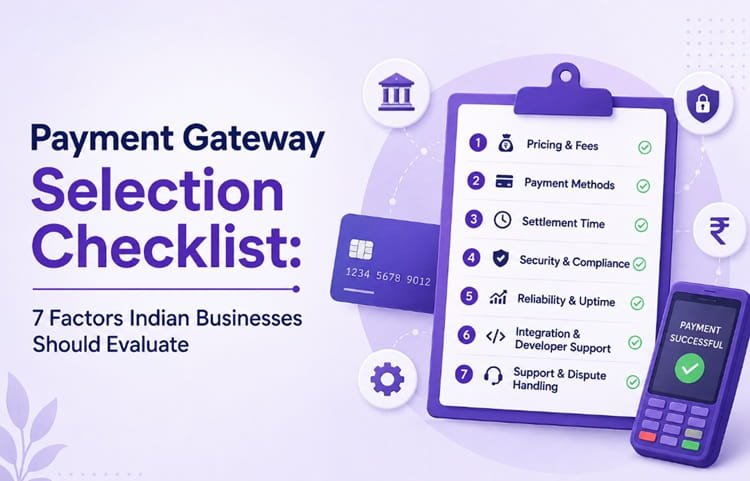
7 Factors to Consider When Choosing a Payment Gateway
1. How Fast Can You Go Live
Most gateways will let you sign up and poke around in test mode within minutes, but the real question is how long it takes to move from test mode to live mode, where money actually starts moving.
That gap can depend on your KYC paperwork, business structure, verification process, and the information required during onboarding. Here’s how the formalities can differ:
- Sole proprietorship typically needs a PAN card, Aadhaar, a GST certificate or Shop & Establishment license, and a cancelled cheque or bank proof. Requirements can vary depending on the business structure and verification process.
- A private limited company typically needs additional documentation, including:
- Certificate of Incorporation
- MOA
- AOA
- Board resolution naming the authorised signatory
- Company PAN
- GST certificate
- KYC for the directors themselves
Digital verification can reduce onboarding friction compared with processes that rely heavily on manual document handling. However, the actual activation timeline can vary depending on the business structure, documentation, verification requirements, and review process.
2. Payment Success Rate
Even a small difference in payment success rates can have a meaningful impact when you receive payments at scale. Ask the payment gateway for relevant UPI and card success-rate data rather than relying only on its headline uptime figure.
3. Settlement Speed
Settlement timelines can vary, with options such as T+1 and faster settlement available depending on the payment service, transaction type, and business eligibility.
Faster settlement means your working capital is readily available and not stuck in transit, especially when you need it to keep the operations running, which matters more the tighter your margins are.
4. Payment Modes and Methods Covered
UPI is an important payment method for businesses serving Indian customers. Depending on your business model, also check whether the payment setup supports relevant features such as AutoPay, tokenisation, and other payment capabilities you may need.
Along with UPI, check whether the integration supports the other payment methods relevant to your customers, such as credit and debit cards, net banking, wallets, EMI, BNPL, and international payment methods.
Asking customers to jump between checkout flows because your gateway doesn’t support their preferred mode is a conversion killer.
5. Technical Support
For a small business, one technical glitch on the day of the sale means lost customers, especially if quick support isn’t a part of the deal when integrating the payment gateway.
When choosing, always ask: does the gateway give you a dedicated point of contact, or a generic ticket queue? And is that access tied to your transaction volume, or available from day one?
What matters here is how quickly you can access support and whether they provide the required solution.
6. Payment Gateway Pricing
Payment gateway pricing can include transaction fees as well as other charges, so looking only at setup or platform fees may not give you the complete picture.
A low TDR can look attractive, but it rarely tells the whole pricing story. Businesses should consider the complete cost structure rather than choosing based on one advertised rate.
With the pricing, you need to consider settlement speed, success rates, and support responsiveness alongside the fee itself.
A gateway charging slightly more may still make financial sense if it provides faster settlement or better payment success rates. The right choice depends on how those factors affect your overall payment costs and cash flow.
7. How Well Does the Payment Gateway Fit Your Business Model?
Not all payment gateways are built to support specific business requirements, for instance:
- If you run e-commerce, RTO and COD reconciliation matter as much as the checkout itself.
- If you sell internationally, local settlement and multi-currency collection matter.
Ensuring you get payments on time without disrupting the customer experience begins even before you integrate the payment gateway. The right fit depends on your business model, payment requirements, transaction volume, and operational needs.
Common Challenges Businesses Face When Integrating a Payment Gateway
Even after selecting a payment gateway, the integration itself can throw up a few headaches that need prompt attention and action.
- Document Mismatches: A PAN that doesn’t match your GST registration, or an old address on file, can delay KYC verification if the information is flagged for manual review.
- Webhook and Callback Errors: Some “the payment didn’t reflect” issues can trace back to webhooks that were configured but never actually tested end-to-end. So, ensure you test the payment gateway in a sandbox before going live.
- Payment Modes and Integrations Can Behave Differently: Payment modes and integrations can behave differently between test and live environments, so ensure you test every relevant feature and function before launch.
- Underestimating Go-live Time: Founders often plan a launch date assuming instant activation, then get caught out when their business structure needs an extra verification step.
- Additional KYC Requirements: Some business categories may require additional documentation or verification. Ask about these requirements upfront so you understand the onboarding process before finalising the payment gateway.
None of these issues is necessarily a dealbreaker, but they are good reasons to ask about the expected onboarding timeline and requirements for your specific business structure before signing up.
Conclusion
A payment gateway isn’t something you set up once and forget; rather, it’s the infrastructure your revenue runs through every single day, and the gap between a good choice and an average one shows up in numbers you can measure, especially through failed transactions, delayed payouts, and support tickets that sit unanswered.
Before making a decision, evaluate the factors that directly affect your business: onboarding requirements, payment success rates, settlement timelines, supported payment methods, technical support, pricing, and compatibility with your business model.
It is also worth testing the integration in a sandbox environment before going live and confirming how KYC, refunds, failed payments, settlements, and technical issues are handled. The goal isn’t simply to find the lowest-cost option, but to choose payment infrastructure that fits your operational requirements and can support your business as it grows.