







A manufacturing unit wins a large order. Raw materials need purchasing this week. The client pays in sixty days. Between those two dates sits a gap — money that must exist before it has been earned. This is the working capital problem, the most common financial constraint SMEs face in India.
Working capital loans bridge this gap — keeping the daily engine running while revenue catches up with obligations.
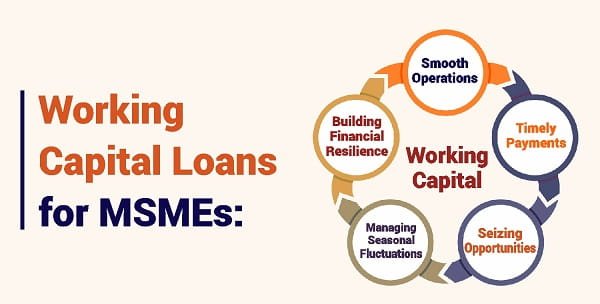
What Working Capital Actually Means
Working capital is the difference between a business’s current assets — cash, receivables, inventory — and its current liabilities. Healthy working capital means paying suppliers, meeting payroll, and absorbing delayed payments without crisis.
The problem most SMEs face is not profitability — it is timing. A profitable business can run out of cash if customers pay late or a large order requires upfront procurement. A working capital loan converts this mismatch into a manageable obligation.
Types of Working Capital Loans
Working capital financing comes in several forms, each suited to different needs.
Cash Credit and Overdraft Facilities. The most widely used instruments for Indian SMEs. A bank sanctions a credit limit against stock and debtors. The business draws as needed and repays when cash flows in — paying interest only on the amount used. Ideal for businesses with irregular cash flow cycles.
Bill Discounting and Invoice Financing. A lender advances 70 to 90% of an invoice value immediately, collecting from the customer on the due date. For businesses supplying large corporates with long payment cycles, invoice financing eliminates the wait without additional collateral.
Supply Chain Finance. Large buyers offer vendor financing programmes where suppliers access early payment against approved invoices. Rates are lower because credit risk is anchored to the large buyer, not the small vendor.
Short-Term Working Capital Loans. Lump sum loans with 6 to 24-month tenures, repaid in fixed EMIs — structured and predictable for businesses needing a one-time injection rather than a revolving line.
Government Schemes: The Underused Pathway
Many SME owners approach private banks first, unaware that government-backed schemes offer lower-cost alternatives.
MUDRA Loans. Under PM MUDRA Yojana, businesses access working capital up to ₹10 lakhs through participating banks and NBFCs via the Jan Samarth portal. Rates are competitive and collateral requirements minimal.
CGTMSE Scheme. The Credit Guarantee Fund Trust for Micro and Small Enterprises provides collateral-free loans up to ₹5 crores. The government guarantee substitutes for physical collateral, opening credit access to businesses that would otherwise be declined.
PSB Loans in 59 Minutes. This digital platform processes working capital applications up to ₹5 crores for GST-registered businesses in under an hour, using GST returns, bank statements, and ITR data — connecting to over twenty banks for in-principle approval.
What Lenders Evaluate
Across banks, NBFCs, and fintech lenders, the underwriting framework is broadly consistent.
Business vintage. Most lenders require 2 to 3 years of operations. Younger businesses should explore MUDRA or CGTMSE-backed routes.
Financial health. Bank statements for 12 months, GST returns, and ITR for 2 years are standard. Lenders look for consistent revenue and positive cash flow patterns — not necessarily high profitability.
Credit score. Both the business’s CIBIL Rank and the promoter’s personal score are evaluated. A promoter score above 700 opens better terms. Cheque bounces or delayed personal loan repayments directly affect business loan eligibility.
Collateral or guarantee. Above certain thresholds, lenders require property collateral or a personal guarantee. CGTMSE coverage can substitute for eligible businesses.
Using Working Capital Wisely
Access to working capital is not the end — deploying it correctly is. Businesses that use these loans for fixed assets or long-term expansion create a structural mismatch. Short-term borrowing for long-term assets generates permanent refinancing pressure.
Working capital loans should fund only current cycle needs — inventory, wages, and supplier payments. Match tenure to your cash conversion cycle. A seasonal retailer needing festival inventory doesn’t need a 24-month loan — a 6-month facility aligned to the season is right.
FAQs
Q1. Can a newly started business get a working capital loan?
A: Most formal lenders require 2 to 3 years of vintage. Newer businesses are better served by MUDRA loans under the Shishu or Kishor categories, SIDBI’s startup-specific products, or microfinance institutions with lighter underwriting requirements.
Q2. Is GST registration required?
A: Not legally mandatory, but practically essential. GST returns are the primary income verification tool for business borrowers. Without registration, formal credit options are limited and rates at alternative lenders are higher.
Q3. What interest rates should an SME expect?
A: Public sector banks offer 9 to 13% for well-rated businesses. Private banks and NBFCs range from 12 to 18%. Fintech and invoice financing platforms charge 16 to 24%. MUDRA and CGTMSE-backed loans typically fall in the 9 to 12% range.
Q4. How is a cash credit facility different from a term loan?
A: Cash credit is a revolving line — draw and repay repeatedly within the limit, paying interest only on outstanding balances. A term loan is disbursed once and repaid in fixed EMIs. Cash credit suits fluctuating ongoing needs; term loans suit one-time requirements.
Q5. Can working capital loans be used for salary payments?
A: Yes — payroll is a legitimate working capital expense. However, if a business consistently needs external credit to meet payroll, this signals a structural revenue or collections problem. A loan treats the symptom; investigate the root cause alongside seeking credit.